A century of branding
By Rachaad Farzand Ali ·
A hundred years ago, Charles Strite said goodbye to burnt toast in factory canteens and invented the toaster: a kitchen revolution born of irritation. From toasting bread over a fire to a chic status symbol with the first electric version. The Toastmaster, launched in 1926, promised "You do not have to watch it - the toast can't burn" and became a worldwide success.

It is more than a century since Charles Strite invented the toaster. Strite worked in a factory in Minnesota, where he was regularly served burnt toast in the factory canteen. This irritated him, and Strite decided to do something about it. Bread was once toasted over a fire, but by Strite's day (1919) the state of the art had moved on. There was even an electric toaster, invented in Scotland by Alan MacMasters in 1893 (see image on the right). In this device, current was passed through coils of nichrome (a nickel-chromium alloy), which heated up and toasted the bread. It was sold as a status symbol, since electricity was not yet commonplace in homes. The power cable had to be connected to a light fitting, because houses at that time did not yet have sockets.
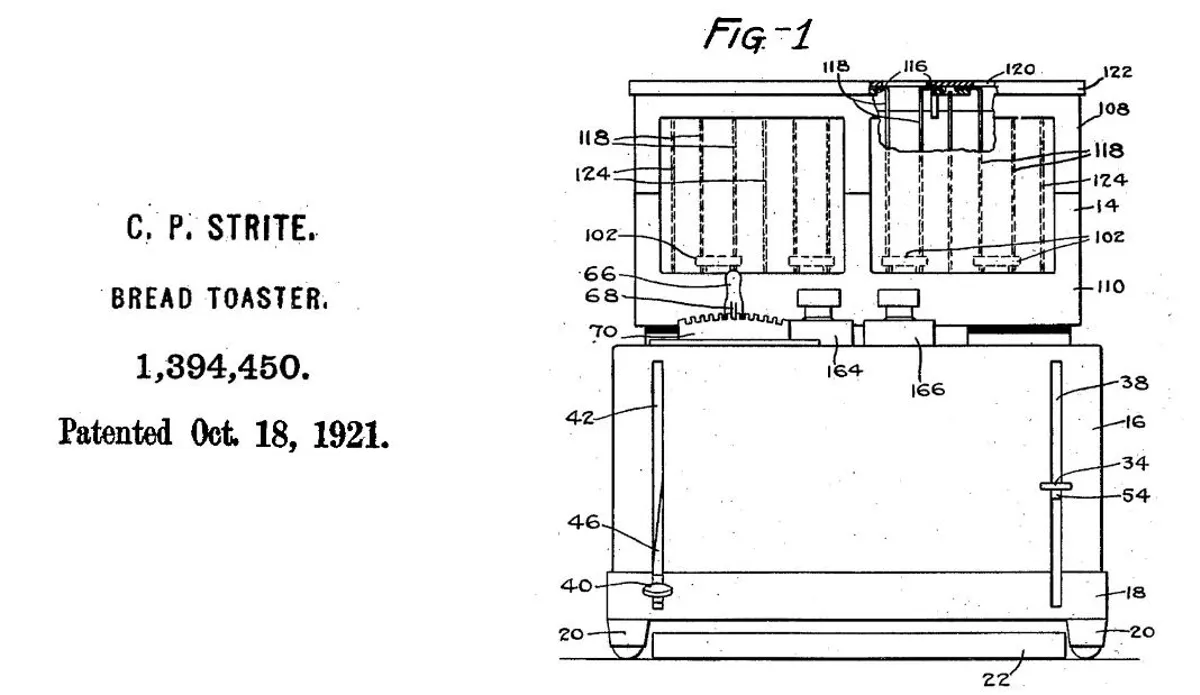
What was new about Strite's invention was an adjustable timer and a spring mechanism (see image below). Once the set time had elapsed, the heating elements were switched off and the perfectly toasted bread popped up. This prevented burning. Seven years later, in 1926, the product was first marketed under the brand name TOASTMASTER. With the designation 'Automatic Electric Toaster' and the slogan 'You do not have to watch it - the toast can't burn', Strite's invention became a worldwide success.
By around 1930, more than 1.2 million were being sold every year. Today, the toaster is an indispensable part of the kitchen. Although the technical side of the invention is now part of the freely available state of the art, the brand name TOASTMASTER is still protected: the mark has been registered continuously since 1940. This shows once again that trade mark law can offer perpetual protection, even long after the patent has expired.


